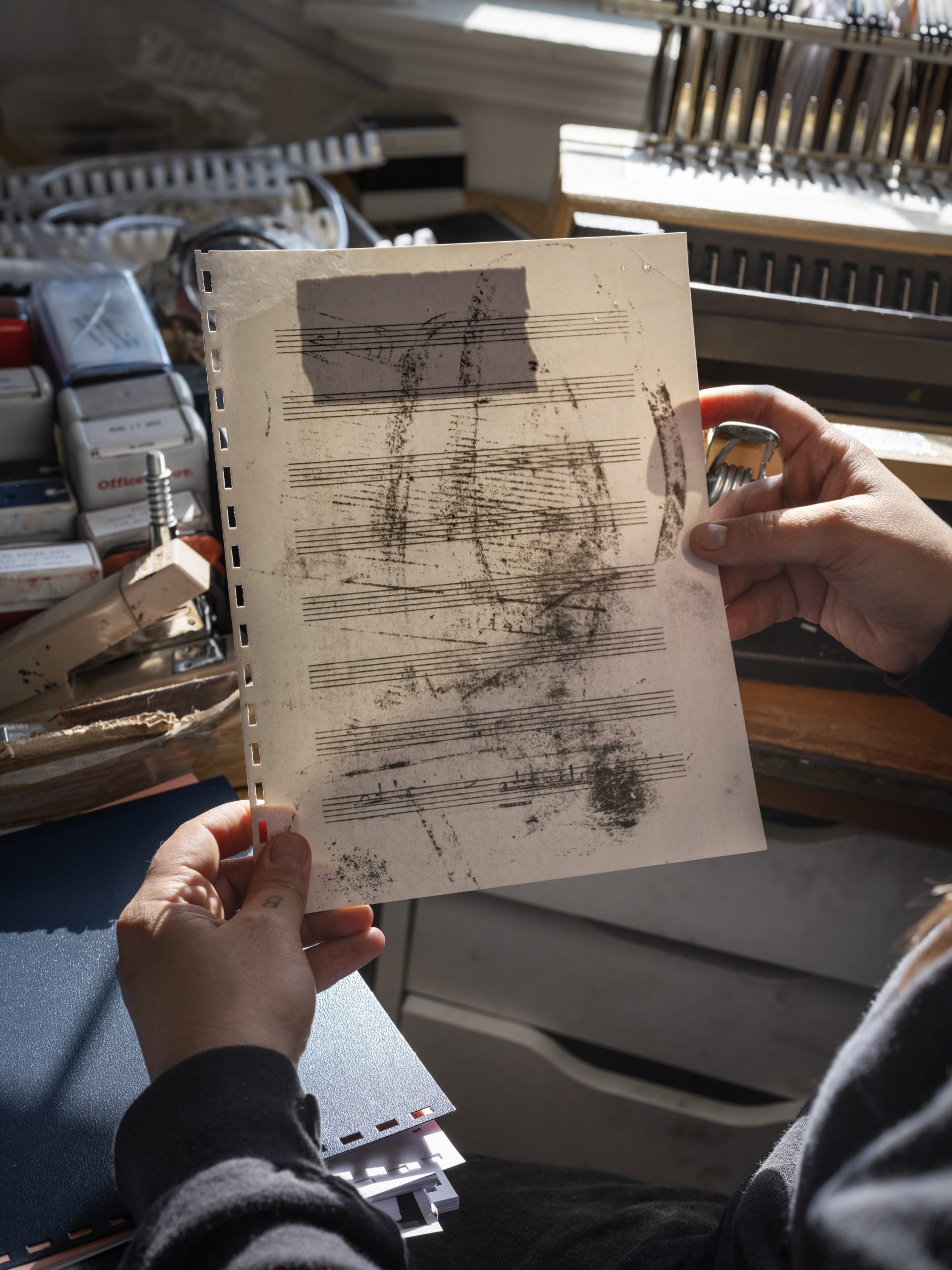
Mo Costello: A Xerox Copied Prayer
Drawing on the legacy of the late Beverly Buchanan (1940-2015), whose practice modeled a radical alternative to institutional circulation, artist Mo Costello enacts her own form of intergenerational transmission through DIY media. Her comb-bound readers, typically distributed at convenience stores in her home base of Athens, GA, are included in this year’s Whitney Biennial: tools created for general accessibility brought into the rarified space of the museum. Costello holds the friction of that recognition close. Her daily, provisional forms of making that constitute the real work, shedding light on the artistic mainstream from the clarity and community of its margins.
– Victoria Camblin, 2026 EIR
“Some of the nicest people live in the strangest self-built houses.” (1)
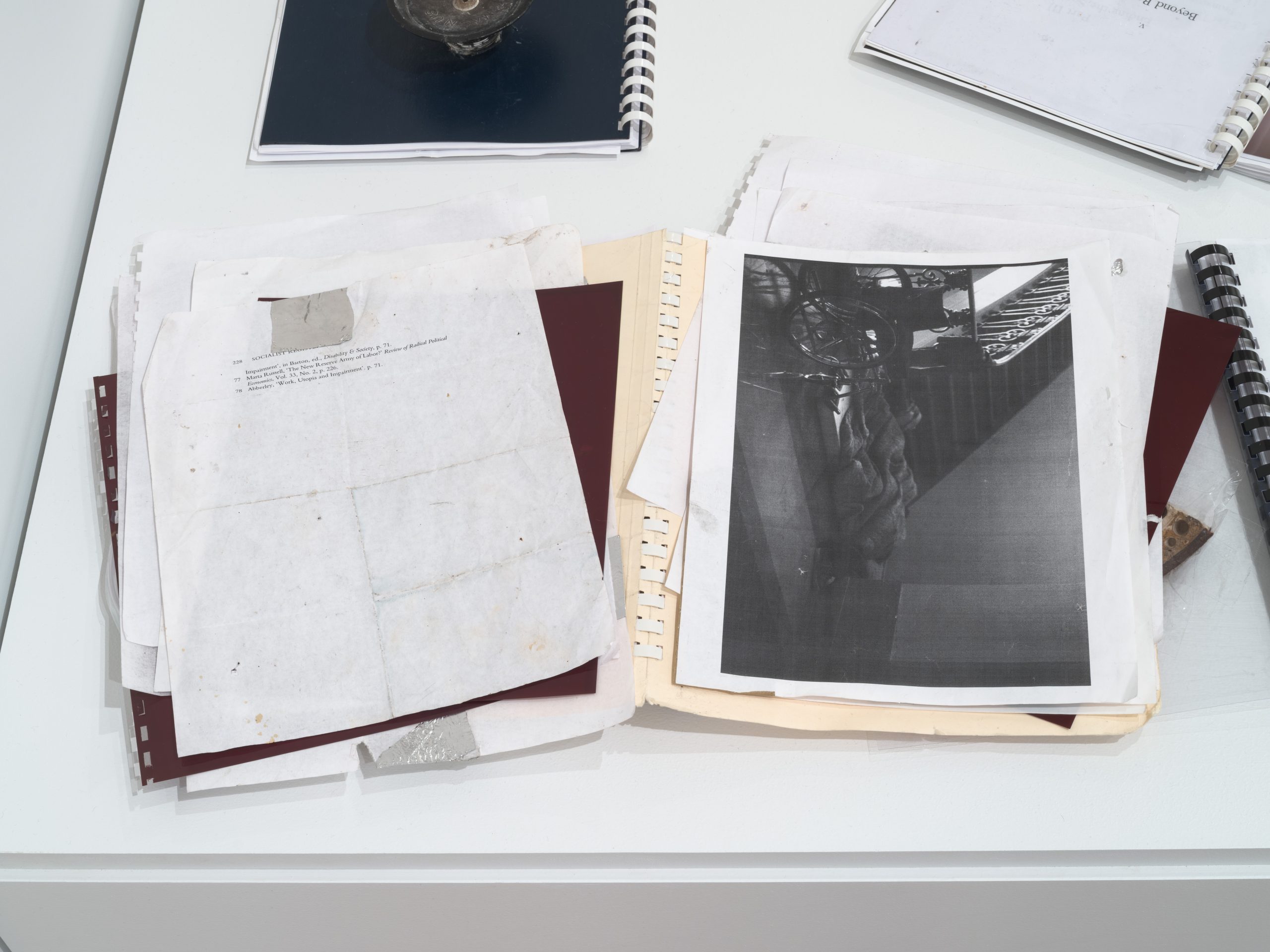
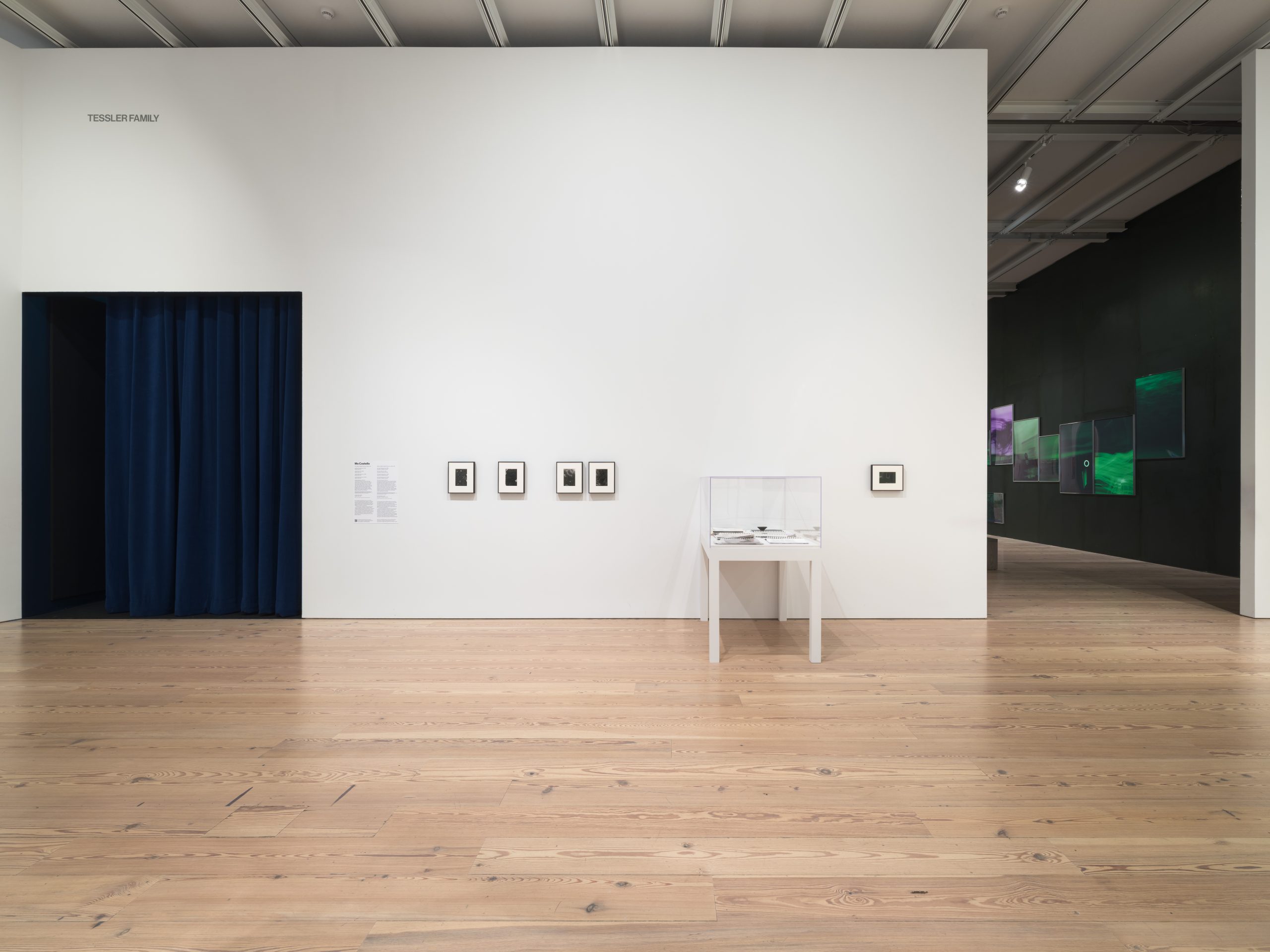
On the sixth floor of the Whitney Museum of American Art, a collection of black-and-white xeroxed essays, books, and images are strewn across the base of a glass vitrine. Some of these texts are visible through the glass: Samuel Delany’s account of New York cruising in Times Square Red, Times Square Blue (1999); Douglas Crimp’s essay “How to Have Promiscuity in an Epidemic” (1987); and selections from scholar Marta Russell’s Beyond Ramps: Disability at the End of the Social Contract (1998). Dog-eared and showing wear from distribution, these readers are a long-term project of Athens, GA-based artist Mo Costello, whose work across photography, installation, and archives explores the complexities of finding community in the face of gentrification, ableism, and modern-day isolation.
A week after her trip to New York for the Biennial opening, Costello and I met in Athens, where she has been living and making art since 2015, when she was awarded a two-year teaching fellowship at the University of Georgia. Seeking community as a working artist and chronically ill person in a southern college town, Costello found a model for social practice in Beverly Buchanan (1940–2015). The late Athens-based artist is best known for her land works and “shack sculptures,” whose posthumous resurgence has been driven by writers and artists who, like Costello, see a blueprint in Buchanan’s approach to art-making that prioritizes a local circle of friends, family, and providers over a traditional metropolitan art scene. Costello greeted me in the front room of the University of Georgia’s Athenaeum, where she and artist, writer, and frequent collaborator Katz Tepper curated Beverly’s Athens: a breathtaking show of drawings, sculptures, text-based works, and archival materials that traces Buchanan’s life in Athens and the communities she forged through her art.
Although Costello was familiar with the shack sculptures, her first meaningful encounter with Buchanan’s work was the posthumous retrospective Ruins and Rituals (2016) at the Brooklyn Museum, curated by Jennifer Burris and Park McArthur — another artist whose practice Costello describes as providing “a critical model for what it is to engage with an artist’s legacy.” In the years following, Costello discovered that she lived a mere block away from Buchanan’s former home, and that friends of friends knew the artist. The most striking similarity, though, is their similar medical routines: they share a pharmacy, Hawthorne Drugs, and Athens Pulmonary Clinic, where Buchanan was treated for chronic asthma and Costello receives care for her own lung condition. Both locales feature heavily in Beverly’s Athens: Buchanan’s network of medical providers became both her friends and, inadvertently, collectors of her work. She would routinely trade art for medical care, and many of the works on display in the exhibition are on loan by her former doctors. One can still see her art in these offices, too. Following a presentation of Buchanan’s work at Hawthorne Drugs organized by Costello in 2023, the pharmacy now displays one of her tabletop Christmas tree sculptures, alongside an original drawing, year-round. Costello says seeing Buchanan’s drawing Hospital Gown Angel during appointments at Athens Pulmonary Clinic provides “a lot of courage.”
In 2023, Costello used her own home to stage a show of Buchanan’s work, drawing from research in Buchanan’s archives and local interviews conducted with the late artist’s associates. The informal exhibition was a success: it was only supposed to be on view for a few days, but it ended up running for three months. Costello’s house, which in other instances has served as a distribution center for mutual aid, turned into a meeting point for Buchanan’s friends to reconnect and reminisce around backyard cookouts and bonfires. The show was a reflection of Costello’s community-minded approach to art-making, inspired by Buchanan’s ability to find “abundance” in Athens despite adversity. “I’m interested in thinking about local access,” says Costello. “How is the work encountered locally, how can we understand where we live in location to the work, and how can we understand artists’ relations to place? I think in Beverly’s work in particular, there are tools for survival.”
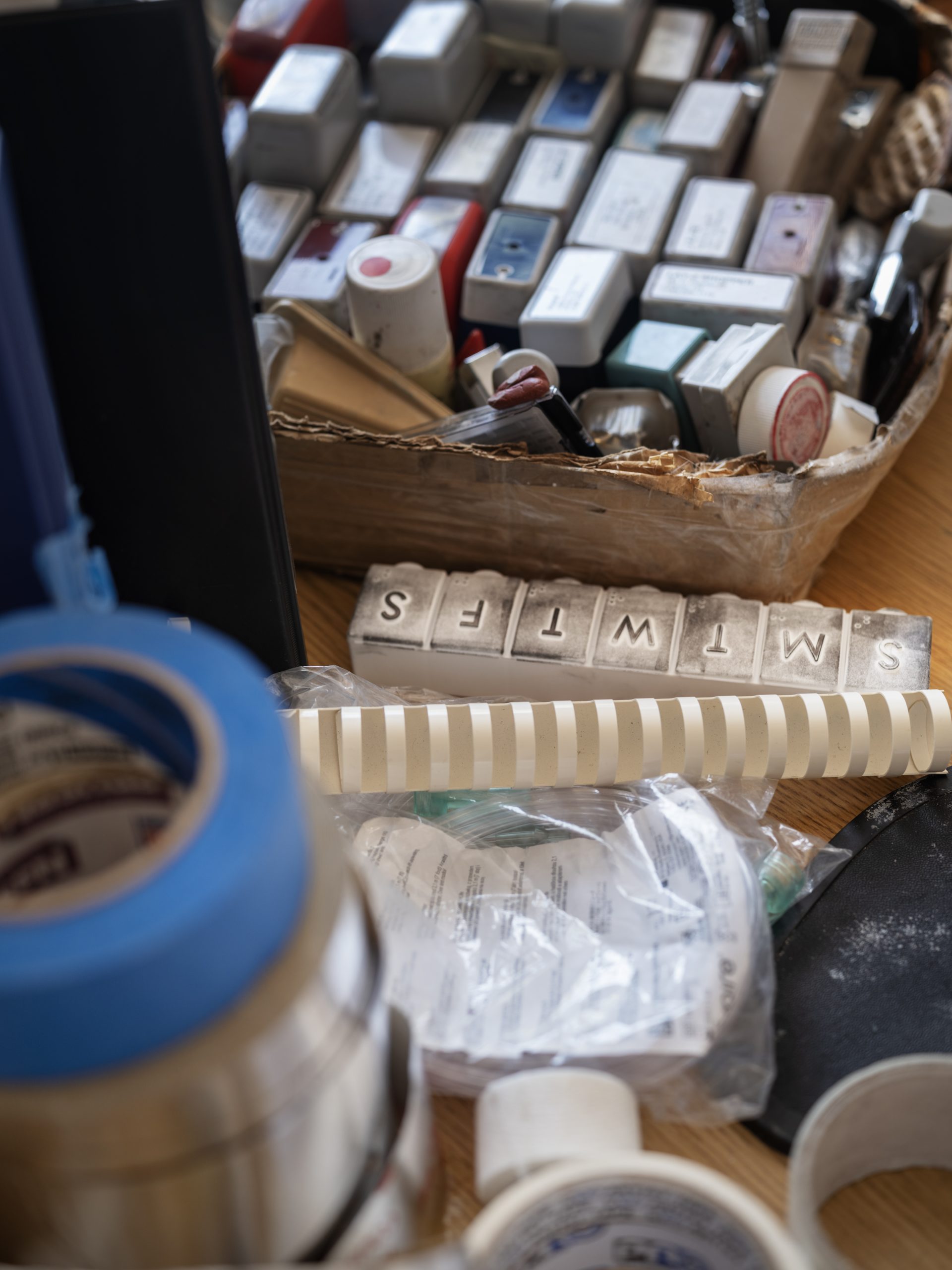
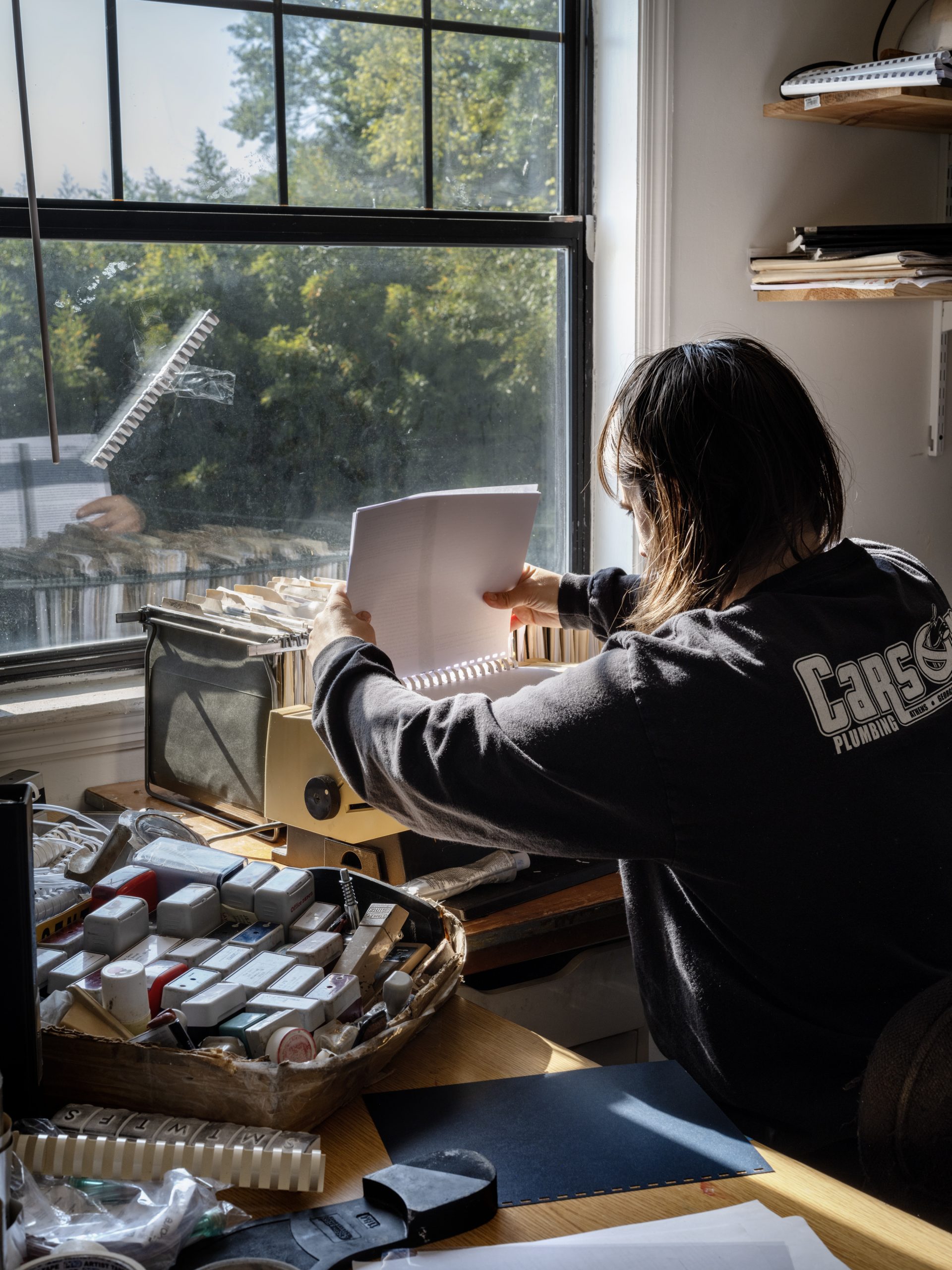
In the weeks leading up to the house show, Costello was approached by Katie Geha, then director of the Athenaeum, to consider staging a version at the institution. The proposal made Costello wary. The home, “as both subject and methodology,” had been integral to the previous concept. But Costello and co-curator Tepper moved ahead with the Athenaeum presentation, eventually securing financial support from the Teiger Foundation. Beverly’s Athens opened at the Athenaeum in January 2026 to rave reviews, with critic and Art in America editor Emily Watlington praising Costello and Tepper for the show’s intimacy, research, and portrayal of Buchanan as “a resourceful person crafting her own network of care outside of capitalism.”
Though Buchanan’s “shacks” are her best-known works, held by institutions such as the Whitney and the Metropolitan Museum of Art, Beverly’s Athens only shows three, including a small, white shack installed alongside Buchanan’s black-and-white photographs of Athens-area homes (Untitled, c. 1991–2000). This decision was both intentional and necessary: the Athenaeum lacked the infrastructure to secure major institutional loans, and Costello and Tepper wanted to ground the show in Buchanan’s “rigorous and expansive” practice beyond the most exhibited works—an approach they believe can help us understand the shacks more extensively. The rest of the exhibition comprises Buchanan’s drawings, photographs, texts, and found-object sculptures, making for a deeply intimate look at a person whose artistic practice expanded into all aspects of life. Walking through the Athenaeum, viewers encounter an ordinary calendar used as a canvas for colorful self-portraits, videos of her garden, and a t-shirt she designed for her beloved Hawthorne Drugs in 1993 bearing a slogan she coined: “People everywhere come to Hawthorne Drugs.” “It’s just not true,” laughs Costello, “which is why I love it.”
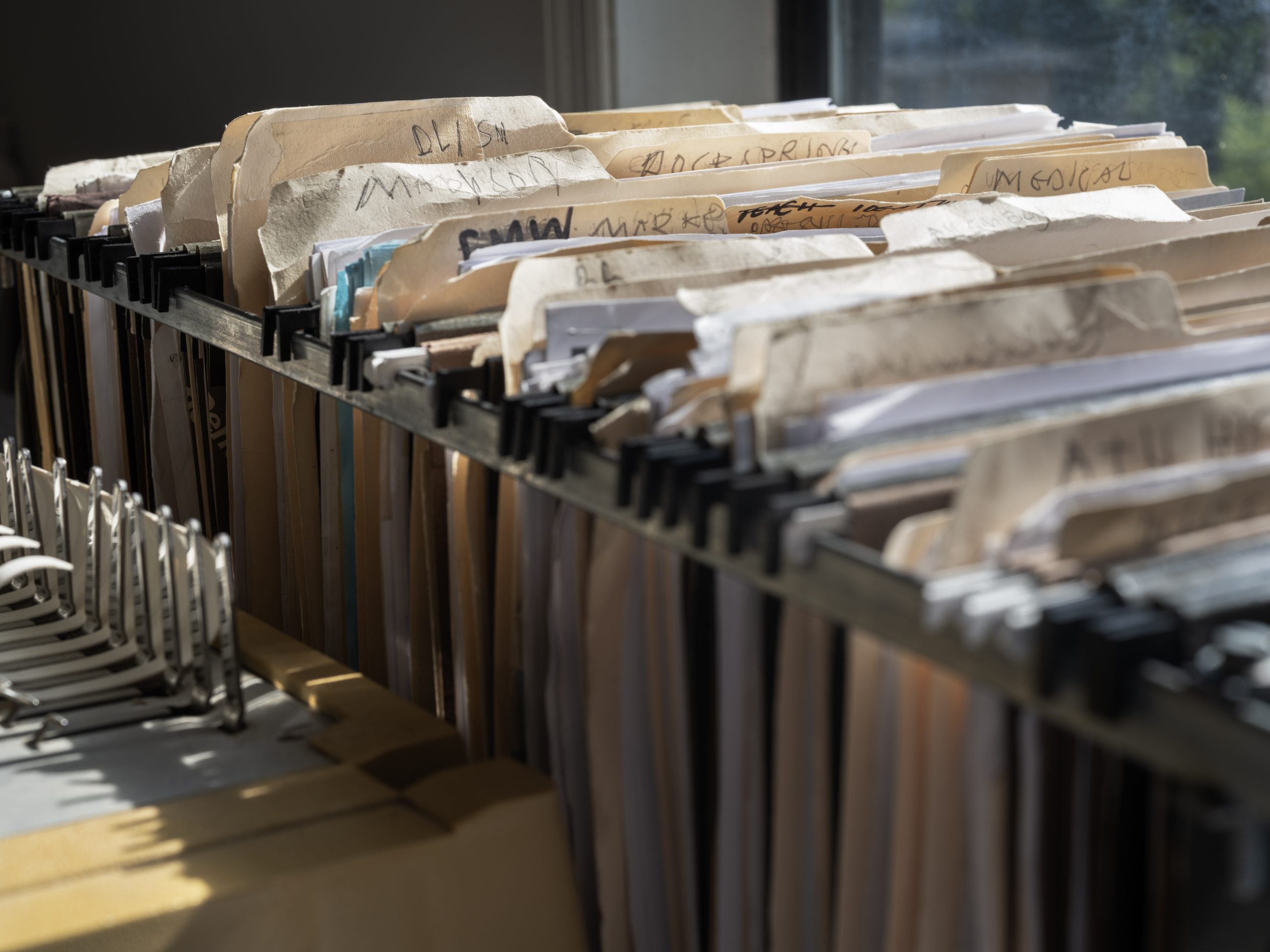
In many ways, Beverly’s Athens is the code to understanding Costello. “While carrying out research, [co-curator Marcela Guerrero] and I were thinking a lot about the idea of the commons and the privatization of public space,” Biennial curator Drew Sawyer wrote via email. “Mo Costello’s photographs and readers beautifully meditate on these issues, and we were excited to situate her practice among artists using other media to explore similar ideas, such as Kainoa Gruspe and David L. Johnson.”
Sawyer and Guerrero requested five black-and-white silver gelatin prints from Costello’s 2025 exhibition at the Atlanta Center for Photography, Forming sounds with my mouth to approximate something that’s like a flood, as well as the aforementioned readers, which date from 2015 to the present. Four of the photographs are taken from an ongoing series wherein the artist captures telephone poles in Georgia. Weathered by time and exposure, these subjects are tightly framed, omitting the surrounding areas to focus on the poles’ rugged surfaces: the bent, rusted nails embedded deep into the wood; the layers upon layers of staples; and, in Untitled (Moreland Ave., I) and Untitled (Moreland Ave., II), both 2025, the dramatic shadows cast by sunlight hitting shards of metal. In Costello’s work, these staples and nails used for local flyers and community information are symbols of “knowledge that has been passed” and “evidence of desire to find one another.” A simple photograph of a telephone pole becomes a portrait of a community, a “look at all the different moments where people are seeking that kind of exchange, that kind of sociality.”
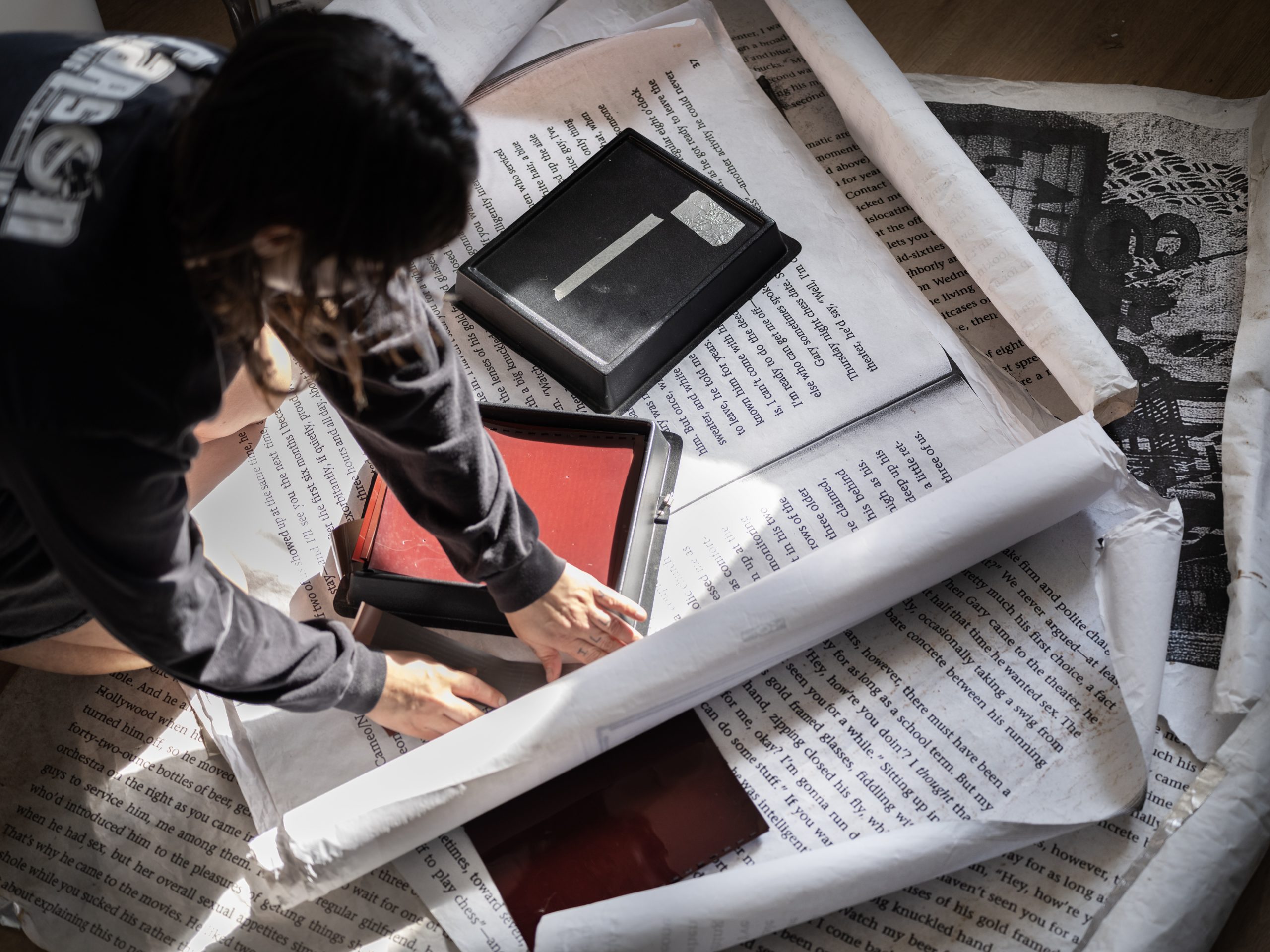
If Costello’s telephone pole photographs depict communities sharing information, her spiral-bound readers put this practice into action. The DIY publications are a “constant” in her practice, one that traces back to her memories of her schoolteacher father making xerox copies for the classroom. She began sharing essays and texts of her own with friends and roommates in college. “I’ve always had an inclination toward reproduction,” she explains. “When I read something, [I find myself] wanting to make copies of it, wanting to share it, wanting to discuss it with others. I’ve always identified as more of a pamphleteer than an artist.”
Costello continued creating the readers when she moved to Athens, both as part of her teaching practice and as a new face in the arts scene in nearby Atlanta, where artist-run galleries such as the now-shuttered Murmur, which focused on DIY media, were vital to the scene. Exploring the encroaching gentrification in the area occupied by many of these spaces, Costello made a reader with selections from Delaney’s Times Square Red, Times Square Blue, a text that is heavily featured in her works at the Whitney, and distributed copies throughout Atlanta’s South Downtown. The artist doesn’t travel to Atlanta as often now—a necessary precaution for a chronically ill person in the post-Covid era. Instead, she distributes the readers at local haunts in Athens: J & J Flea Market, the Krystal drive-through across the street from Delta Tau Delta fraternity house, and the convenience store Lay-Z-Shopper, to name a few.
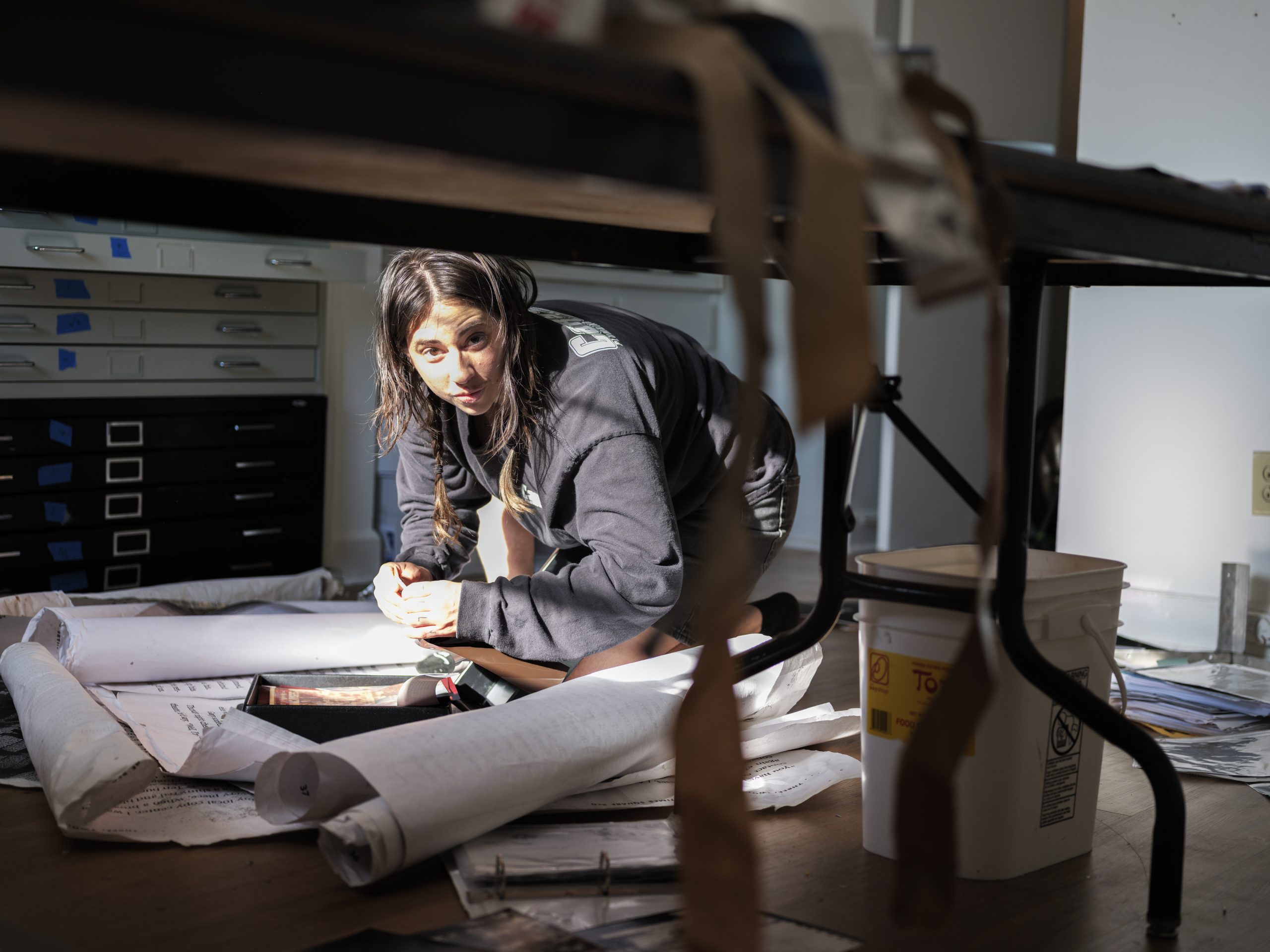
Considering the role these publications serve in Costello’s practice, there’s an odd tension in their installation at the Whitney, where a vitrine makes these tactile objects intended for distribution inert, stripped of their initial purpose. Their production “isn’t contingent on access to the gallery,” says Costello, noting this friction as inherent to these works’ display. “The decision to use the vitrine was also acknowledging that tension,” she says. “They weren’t made for this space … The most they can do is sort of point to their use elsewhere.”
Many of the works in Beverly’s Athens have never been shown in a gallery or institutional setting. Buchanan’s glorious pastel-on-paper flower drawings were rarely bought or sold in her lifetime. Costello and Tepper were told that she would hide these drawings when her gallerist visited, and instead routinely used them as gifts or bartering items. Costello, too, largely operates in the margins of the art world, both geographically and medium-wise. (Costello’s gallery, april april, is in Pittsburgh, not in New York.) “So much of being in Athens for me has been, how do you find audience, and what is audience?” she says, referring to the audience for art as “both a real and imagined thing.” Costello’s focus is local and hands-on. “The exhibition is the exception; the rule is the daily, provisional form of making.”
Costello and Tepper were mindful of the language that Buchanan used in her writing, carrying her repeated and preferred terminology over to the Beverly’s Athens exhibition texts: “guardianship” refers to the close network of friends and caretakers who attended to Buchanan’s needs at home; “enforced despair” describes the racist and classist discrimination she faced outside it. The curators also picked up on Buchanan’s spiritual motifs, best seen in the Hospital Gown Angel drawings. In her own way, Costello shares this spiritual vocabulary. “[A] term I use a lot is prayer, because the repetition for me is really important,” she says. “[Photographing] the telephone poles approach a kind of prayer.” There is magic in each flyer and xeroxed copy, too: a public wish for community amid widespread loneliness.
Madeleine Seidel is a curator and writer based between Brooklyn and Atlanta. Seidel is currently an assistant curator at Performa and a regular contributor to international publications such as Frieze, Burnaway, Interview Magazine, and others.
Jill Frank is an Atlanta-based artist and educator. She has had solo shows at the Museum of Contemporary Art Chicago and Museum of Contemporary Art Georgia, and reviews of her work have appeared in Artforum, Art in America, and The Paris Review. Frank is an Artadia Award recipient and assistant professor of photography at Georgia State University.
(1) Beverly Buchanan, “WHAT ARE THESE NEW STRUCTURES,” archival material dated January 1, 1993.
(2) Emily Watlington, “How Beverly Buchanan Crafted Her Own Economy of Exchange,” Art in America. Published January 22, 2026.