Abigail Lucien: Blood of the Earth
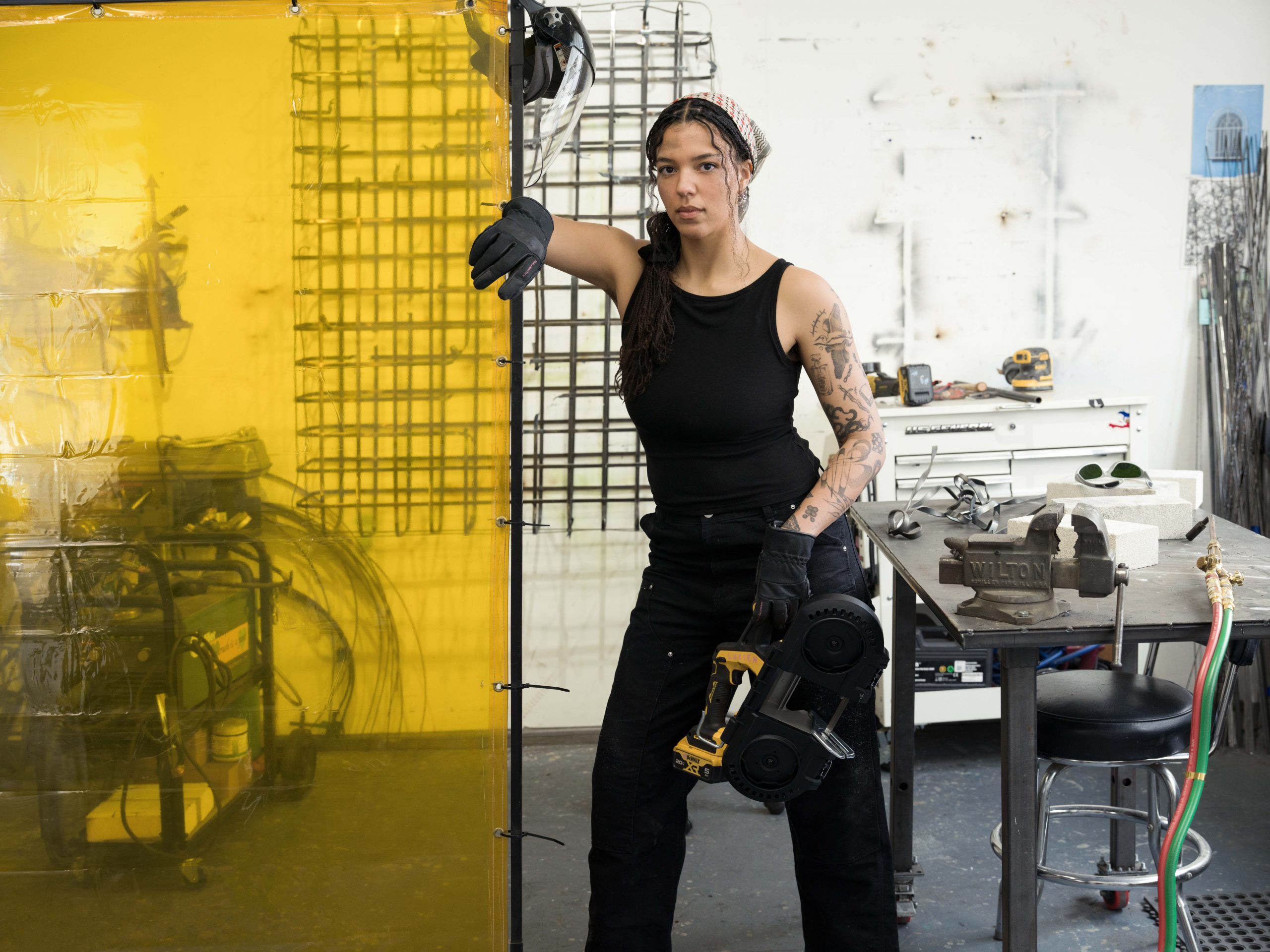
Our ancestors carried a deep material intuition—an understanding of the earth and its substances that continues to resurface today through acts of making, study, and observation.
That is the thought that lingered with me after my conversation with Abigail Lucien, whose latest solo exhibition, Blood of the Earth, contemplates the nature and origins of iron.
Long before iron became infrastructure, weaponry, architecture, or art, it arrived on this planet through celestial processes that far exceed human time. The same element flows through our blood and moves through the earth beneath our feet.
Across ancient Africa, blacksmiths and metallurgists developed intimate relationships with a material born from stars. The ironworker was revered, occupying roles that bridged technology, spirituality, and community life. Through hand, hammer, and fire, they transformed earth into technology.
Rooted in traditions of making, study, and apprenticeship, Lucien’s work considers how knowledge travels through materials across generations. Throughout our conversation, iron emerged as a record of planetary formation, a carrier of memory, and a teacher. In Blood of the Earth, material origin and cultural transmission are part of the same story.
— Tash Nikol
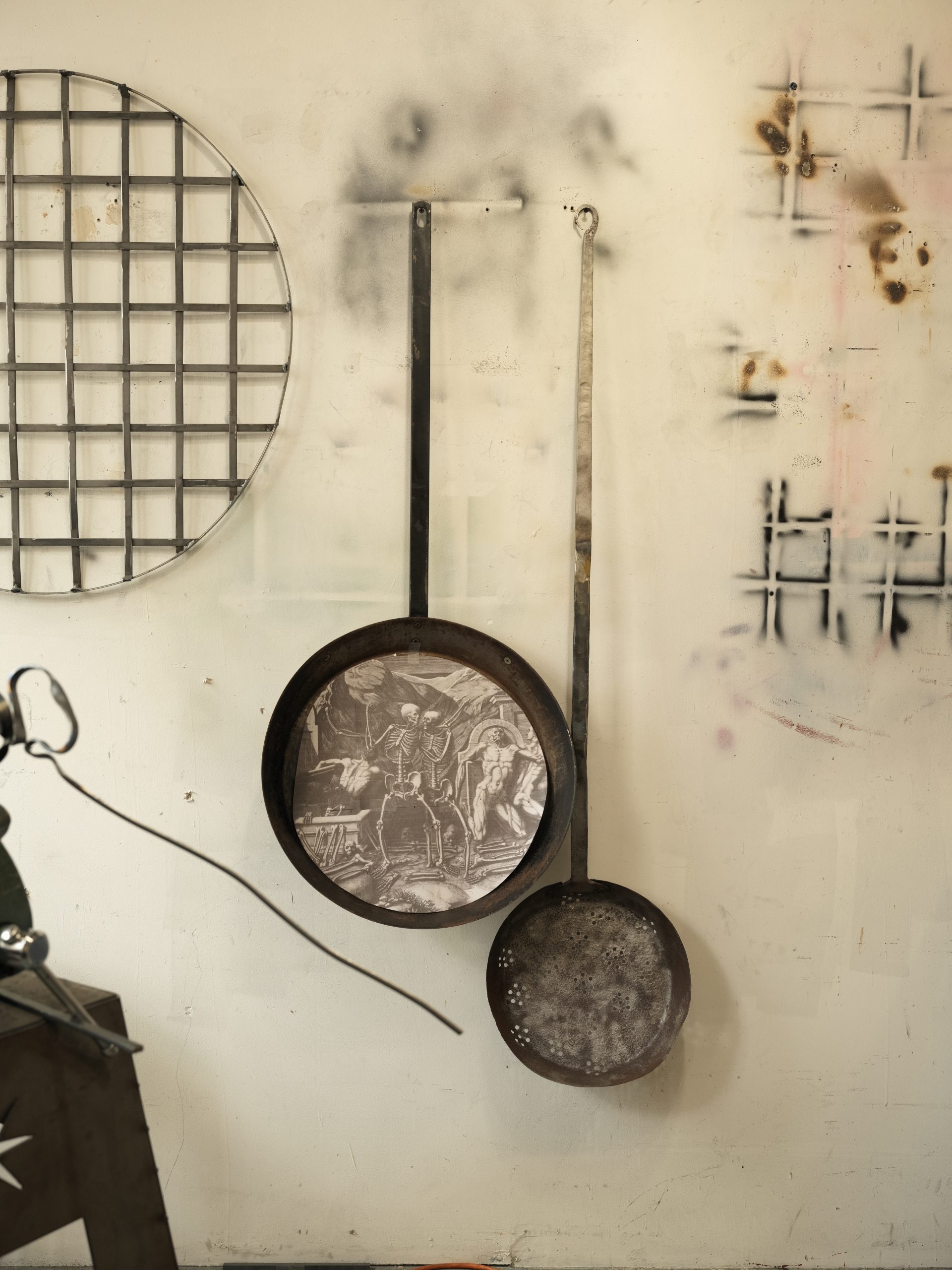
Tash Nikol: When did iron begin to reveal itself as more than a material and become a subject of inquiry in your work? How has your relationship to iron evolved since?
Abigail Lucien: For me material has never really been separate from the subject. I think of sculpture as a poetics of material. Whatever vehicle that poetics needs, it calls for a grounding matter.
With metalworking, metal has always been both material and subject. What has changed is my understanding of it. That’s natural in any practice: you follow what you’re drawn to, and that attraction pushes you to deepen your understanding. Not from naïveté, but from a need to develop a more complex relationship to the material—how it functions in the world beyond how you meet it as just a person. Over time, that poetic emphasis has become a deeper part of my practice. Blood of the Earth is a major deep dive into iron, steel, and metal craft as a whole, but it’s part of a much larger practice, not its entirety.
TN: In your artist talk with Jessica Bell during your recent solo exhibition, Wrought, at Nicola Vassel Gallery, you spoke of the work as being under “distress” by fire, through a process of manipulating heat to cut, to fuse, to join, to patina, to create different movements or colors. It’s incredible to think about how iron and metal work across different elements in this poetic expression that relates to bodies, adaptation, and change. How do you feel these materials might hold memory?
AL: I think about memory on micro and macro scales, and all these spaces in between.
On a micro level, metal as a mineral in the body literally carries memory into our bloodstream. Iron helps us retain memory in biological ways. On a formal level, there’s also the way metal can be both soft and firm enough to retain a movement. There’s memory in that.
I talk to my students about the soda can tab that is made of aluminum: if you bend it back and forth, back and forth, eventually it breaks. That’s an easy way to remember material fatigue as a kind of memory.
On a macro level, materials hold memory in a historical sense that feels almost mythological or sacred to me, like a time capsule. Minerals can be traced back billions of years through scientific methods. I’m intrigued by the idea that we might intuitively feel that depth and be drawn to certain materials because of it—even if we don’t know the exact origin point of a specific piece of iron. We know it through the life of our sun, through stellar processes. There’s something powerful about working with materials that hold time and become vessels for its memory.
TN: That makes me think of the book Vibrant Matter: A Political Ecology of Things by the political theorist Jane Bennett, and the idea that material objects have a vitality that can influence and change us just as we do objects. I’m curious about that in your practice: as you’ve learned more about the science and gotten more connected to iron, how do you feel the material has changed you over time?
AL: I definitely feel like it’s changed me. It’s hard to know how different things would be if you’d taken another path or removed one element of your life. But iron and steel have given me a particular way to think about change and time.
As a metalworker, there’s a process-based relationship that has always been central to my practice. That process has become a way of understanding the world. It’s rooted in how I came up as a young printmaker—through process and community, moving through stages and evolutions.
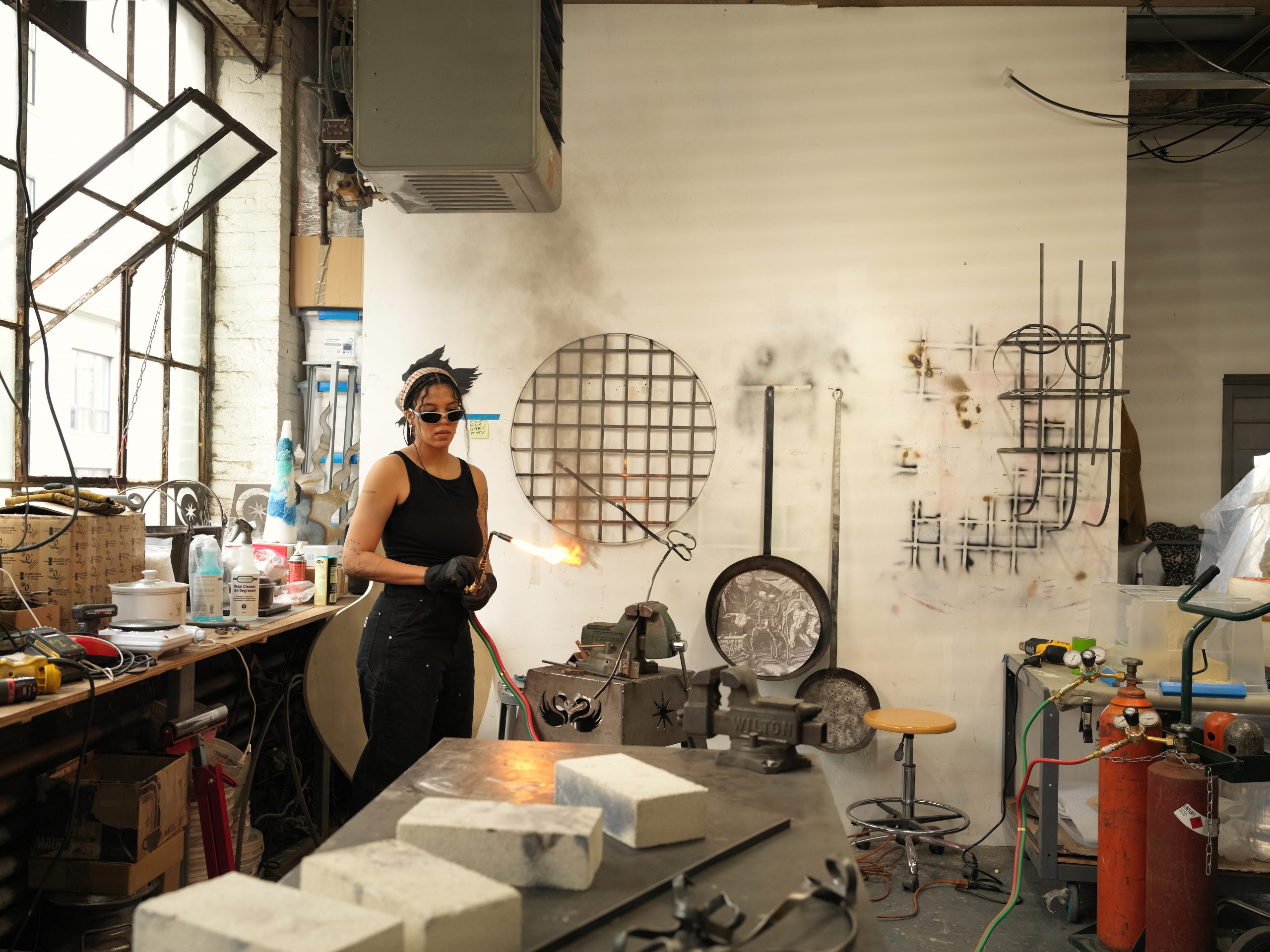
When the pandemic began, I was already metalworking, but I leaned deeply into it. I couldn’t stand being in front of a screen. Grief felt intense—personal, national, international. The thing that gave me the most agency was moving something with my hands. I found myself in a metal shop, and it felt like I had a new kind of agency: to bend something to my will.
That sensation has stayed with me: the ability to build in a space that holds contradictions—strong and soft, complicated and simple, all at once. Working with my hands, slowly, teaches me how I want to understand the world.
“The planet has been ‘metalworking’ for a very long time—through volcanic activity, extreme heat, and pressure. Human metalworking technologies grow out of paying attention to those processes and then adapting, systematizing, and passing them on.”
TN: Your solo show at the Art Institute of Chicago is called Blood of the Earth. How did you arrive at that title?
AL: The show is curated by Irene Sunwoo, who chairs the Architecture and Design department at the Art Institute of Chicago. When Irene invited me to explore different collections, two of the institute’s curators—Jonathan [Jonathan Tavares], the associate curator of Arms, Armor, and European Decorative Arts, and Costa [Petridis] from Arts of Africa—took me into their archives.
Those visits really became the vessels for the research.
Before I even came to Chicago, I told Irene I wanted to do a show about iron, but I didn’t yet know what that meant. After seeing the collections and reflecting on my own community relationships to iron, things clicked quickly.
The title comes from thinking of iron’s celestial origin. Its arrival from stars that predate our solar system, and its role in our bodies and evolution. Iron is vital to blood, to our survival. So iron is both literally and metaphorically blood of the earth: it forms our planet’s core and circulates through us.
TN: You’ve described the exhibition as a speculative workshop inside the gallery. What does the workshop represent for you?
AL: Part of what drew me to printmaking originally was the shop model. You rely on each other. You share equipment. That sense of shared infrastructure carried through when I started metalworking. I’ve managed many shops as jobs and still do in certain capacities.
There’s a certain way community has to be nurtured. It doesn’t just happen. That’s central to those spaces. But I also think about the individual workshop or studio as a kind of rich soil, a birthing ground—a place where things can happen.
For this exhibition, I’d been thinking about the workshop as a kind of fertile ground, almost as if the room were the core of our molten earth, and inside there’s this hammering and changing and working. To think about the room as a living space that takes on the energies and impressions of the people who work in it. I’m interested in that in a mythological way.
TN: I really appreciate that idea of the workshop as fertile ground and as a space that absorbs the energies and impressions of the people who work within it. In many African and Caribbean traditions, the forge has also been understood as more than a site of production. It’s a space of creation, knowledge-sharing, community, and spiritual practice. It’s easy to think about blacksmithing as something nostalgic or belonging to the past, but these traditions continue in different forms today. Do you think of metalworking as a technology?
AL: I think of technology very broadly. For me, technology is any kind of connective tissue, a way something mediates or structures a process. It doesn’t have to be metallic or “futuristic.” Basket weaving is a technology. Looms are a technology.
Metalworking is a technology in that same sense. When you think about iron and meteoric composites, and then smelting and forging, there’s this long history of people learning from ecological phenomena. One story about iron smelting is that someone came upon a fire where iron ore had been accidentally smelted. They recognized that something had changed and learned from it.
The planet has been “metalworking” for a very long time—through volcanic activity, extreme heat, and pressure. Human metalworking technologies grow out of paying attention to those processes and then adapting, systematizing, and passing them on.
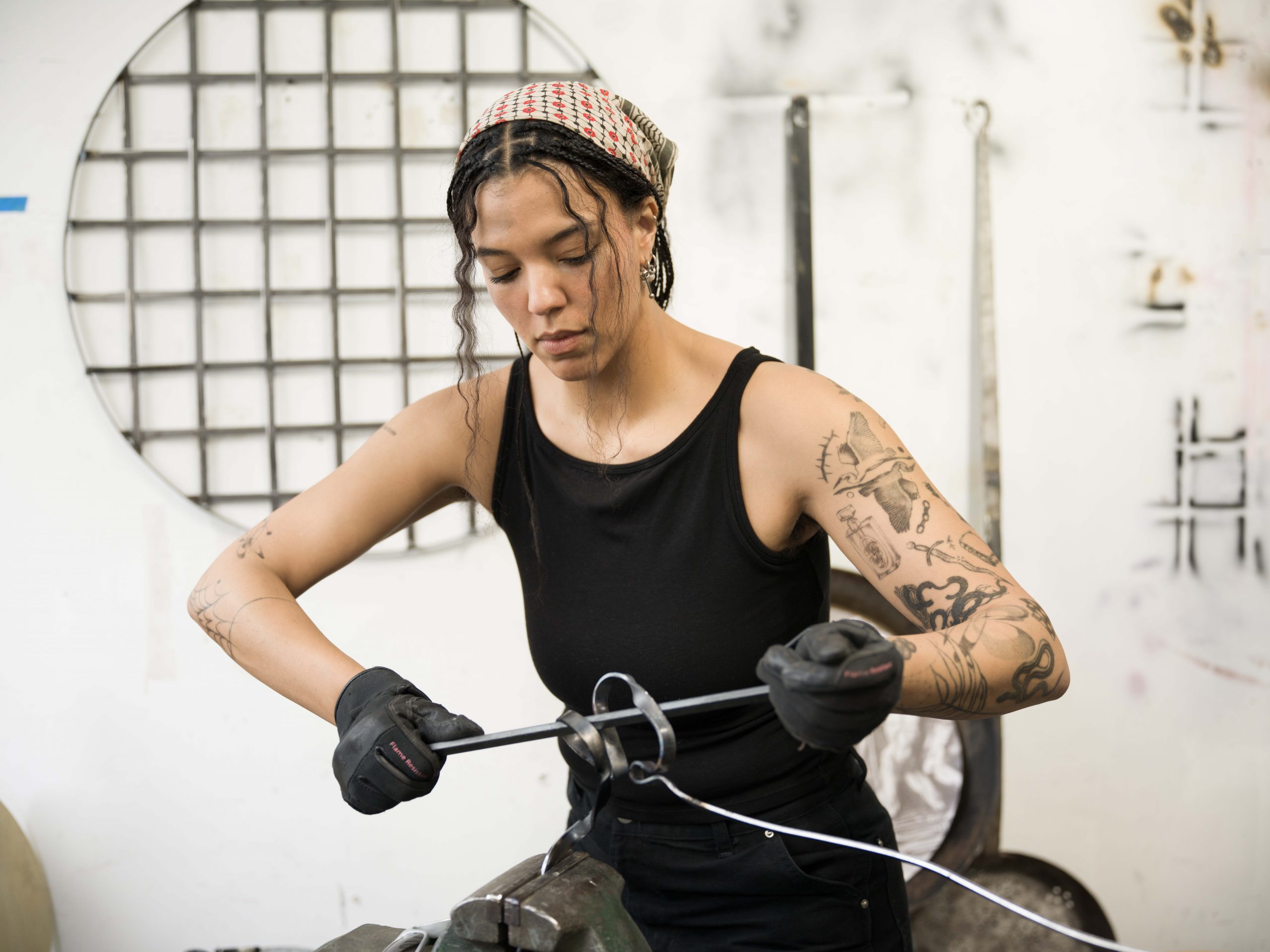
TN: Hearing you describe it this way, I keep coming back to the Yoruba Orisha Ogun, a deity associated with metallurgy, and to this idea that technology isn’t separate from culture, spirituality, or everyday life.
AL: The furnace I made for the exhibition—which is centered in the show and birthed many of the objects on view—is named after Ogun. Her name is Manman Ogun.
I’ve been thinking a lot about how Ogun, as the god of iron, travels: Ogun in Africa, but also in Brazil and Haiti, in Vodou traditions. That spiritual shifting across geographies tracks a material and technological shifting too. As spirituality moves, it adapts to different ecosystems and technologies.
If you think about forging or casting in a Caribbean climate versus a desert climate, those ecologies shape the technology. I’m really interested in how spirituality travels within a material, and how the forge or furnace can hold that.
TN: In Wrought, you used smell, scent, and environment to create an atmospheric space. Are you carrying that into Blood of the Earth, creating environments of the diaspora that your work and the visitor’s experience might live in?
AL: Yes. There are two pieces in particular that use ephemeral materials to speak about change and location. They’re both based on tools you’d find in a smithy.
One is a large cone mandrel, typically used to create curves or circles in the forge. In the show, it’s made of salt, which let me think about iron and blood, salt and blood, and also salt in relation to the Atlantic Ocean and transatlantic movement.
The other is an anvil cast in cocoa butter. I wanted to take these traditionally solid, hard tools and render them as sensual, changing, vulnerable bodies. They still hold the “essence” of the tool—a proposal of how you might use it—but instead of just shaping metal, they shape the user’s imagination, the user’s body. It becomes about the exchange between bodies and materials.
“Iron and steel have given me a particular way to think about change and time.”
TN: What has following iron’s origins revealed to you?
AL: My interest in iron is deeply tied to its cosmic history—where it comes from and how it exists on Earth.
As an educator, I’ll ask students, “where does this material come from?” You walk it backward: from the metal to the mountain, to volcanism, to stellar events. Iron is populated into the universe through supernovae—exploding stars. That’s a whole long story in itself, but it’s central to understanding planetary formation.
There’s a theory that Earth collided with a “sister planet” dense in iron. Those two bodies merged, giving us our iron core and our moon. That collision, plus billions of years of volcanic activity, torrential rains, and geological cycling is how iron becomes part of the Earth’s crust.
Later, microscopic organisms in the ocean interact with and “rust out” iron deposits, changing them over eons. Other planets, like Mars, also have deep iron deposits; we see Mars as red partly because of iron in the soil oxidizing.
Because iron enters our solar system after a star’s explosion, it’s older than our current sun. That’s wild to me. You can go deep into the science, but for me it’s also about valuing a limited material that is older than almost everything we know, while being essential to our existence.
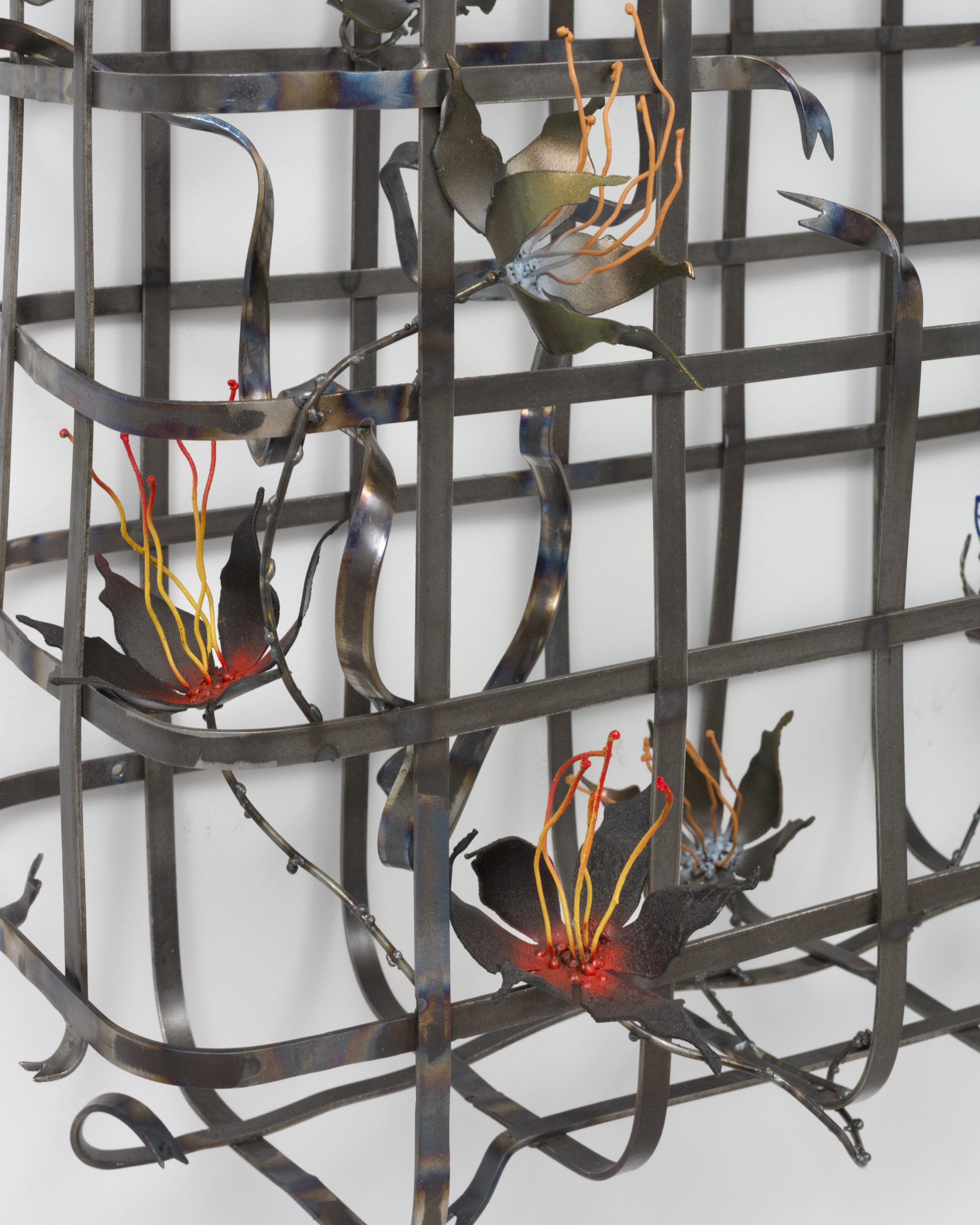
Abigail Lucien, “To Unravel A Wrought,” urethane and enamel on powder-coated steel, 2026.
TN: From printmaking to now: how has your knowledge traveled across different stages—student, artist, educator?
AL: I try not to think of “student,” “practicing artist,” and “educator” as linear stages. For me, they’re simultaneous, always happening. I learn a lot from my students, and I learn through the act of teaching, digesting information so I can share it. All of that is anchored in being a practicing artist.
It took me a long time to understand that I’ve basically been doing similar things across different media. The practice is the through-line; the medium is in service to that. As a younger artist, I felt more comfortable calling myself a printmaker than an artist. I don’t come from an art background, and I didn’t grow up seeing “artist” as a viable professional path.
But when I look back at my early work, those prints were already soft sculptures: sewn together, translucent, hanging. They were pushing the boundaries of what printed media could be. I was already dealing with themes that are still present: authenticity, originality, multiplicity, community, and the democratic multiple.
Those concerns carry into mold-making and sculpture. I’m a dedicated mold-maker because I love watching forms move through different materials, or through acts of copying. Metalworking became a way to draw in space, to move line through space with more control. It took time to stop treating these media as separate categories and instead see their continuity. Of course, they do differ, and I had sculpture impostor syndrome for a long time. I didn’t study sculpture, and I wasn’t raised in a car garage—I didn’t have that stereotypical background.
I entered metalworking through one of my closest friends. I had an idea for a project and asked her to weld it for me. She said, “I’ll show you how to do it, and then you can do it forever.” That changed my life. Later, when I went back to Haiti, I looked around and realized: this has always been here. Metalwork is everywhere in my visual history, but I hadn’t yet known how to look at it. It’s like falling in love with something. Once you do, you see it everywhere.
That’s what metalworking became: a way to trace something that felt deeply tied to my ancestry and to the things already embedded in me.
“Metal as a mineral in the body literally carries memory into our bloodstream. Iron helps us retain memory in biological ways. On a formal level, there’s also the way metal can be both soft and firm enough to retain a movement. There’s memory in that.”
TN: What does it mean to you to teach someone not just how to make something, but how to think through making? Especially with metal, where cast iron, wrought iron, and steel all demand different processes, tools, and forms of touch.
AL: There are different levels and curves to learning, especially in the shop. There’s a lot of technical stuff, and it’s often tied to safety.
In my first job as a shop tech, I spent a lot of time taking machines apart and putting them back together, so I wouldn’t be intimidated. Knowing how something works lets you get over that fear. I use that same philosophy with students: if they understand what’s happening mechanically, the shop feels less overwhelming.
With metalworking and sculpture, a lot of it comes down to practice. The things we do—hammering, bending—are simple actions, but mastering them takes time. You develop muscle memory and learn to listen to the material and to yourself.
When I teach, I try to help students recognize that the conceptual and the technical aren’t separate. The analytical part—the thinking through how something comes together—is sculpture. The conceptual is embedded in the physical choices, in the moves you make. It’s beautiful to watch students reach that moment when they realize they’re actually learning to trust their own intuition.
TN: When you think about your work years from now, what do you hope endures? The objects themselves? The ideas they carry? The relationships?
AL: What I most want to endure are the ideas.
Some of my work is intentionally ephemeral; it won’t exist forever. It will evaporate, melt, morph. But the ideas—especially around community, lineage, and this braid of ancient and contemporary time—can remain.
With this project in particular, I’m drawn to the sense of situating ourselves within a lineage that exists before us and after us. The Chicago show brings together something ancient, something contemporary, and something speculative about the future.
I hope people can look at the work now and feel invited to speculate—and that this speculative thinking can continue as the work and the world change.
Tash Nikol is a writer, design researcher, and book artist from the American South, and the founder of the independent publisher Grace Issues. Their work engages archives, materiality, and the environment through craft and community, centering Black and Indigenous traditions of survival, earth-keeping, and ingenuity. In 2026, they received the Paula Rhodes Memorial Award from the School of Visual Arts for their inquiry into the lineage of ironwork in the Gulf South while in the Design Research and Writing Criticism MA program.
Abigail Lucian’s Blood of the Earth is on view at the Art Institute of Chicago through January 25, 2027.